

Paraben Free Candles: What the Label Means and What to Check

A paraben free candle is one whose wax, fragrance and dyes contain no paraben preservatives. The claim is easy to make and hard to verify, because parabens are a cosmetics ingredient that rarely belongs in a candle at all. The label tells you less than the ingredients that are actually in the flame: the wick, the fragrance and the wax. This guide covers what the claim does and doesn’t tell you, and the checks that protect you better.
TL;DR
- Parabens are preservatives used mainly in water-based products like lotions. A candle is wax and fragrance, so “paraben free” is often true by default and says little about quality.
- The checks that matter more: a lead-free cotton or paper-core wick, phthalate-free fragrance, and a seller who will answer ingredient questions.
- Burning any candle makes fine particles. Ventilation and wick trimming change your air more than any single label.
- We pour our candles with phthalate-free fragrances and lead-free wicks. If you need a paraben-specific answer for a given scent, ask us before you order.
Table of Contents
- What parabens are, and why they show up on candle labels
- Is the paraben claim meaningful?
- What matters more than the paraben label
- A quick comparison of common claims
- Burn it so the air stays cleaner
- Candles and pets
- Our perspective
- Buying a personalized candle you can feel good about
- A shopping checklist for paraben free candles
- FAQ
- Sources
What parabens are, and why they show up on candle labels
Parabens are a family of preservatives. Cosmetic makers add them to products that contain water, such as lotions and shampoos, to stop bacteria and mold from growing. The Cosmetic Ingredient Review’s expert panel assessed 21 parabens in 2020 and found 20 of them safe in cosmetics at a total concentration up to 0.8%.
That finding is about skin products. It does not tell you what happens when a compound is heated in a flame and inhaled, and it does not describe candles. A candle is a block of wax with a wick and a fragrance. There is no water to preserve, so there is little reason for a preservative to be there.
So why do labels and ranking pages mention parabens? Because “paraben free” has become shorthand for “clean.” Many brands list it next to “paraffin free” and “phthalate free” as a package. Some of those claims are meaningful. Some are the candle equivalent of a “gluten free” sticker on bottled water.
Is the paraben claim meaningful?
Honestly, only partly. Here is how we would read it as a shopper.
It is a reasonable signal that the maker pays attention. A brand that lists what it leaves out has probably thought about what it puts in. That is a good reason to look closer, not a reason to buy.
It is not a safety guarantee. The National Candle Association says there are no known health hazards from a well-made, properly burned candle, scented or not, and also notes that people sensitive to fragrance may react and should burn candles in ventilated rooms. In other words, the conversation is about how a candle is made and burned, not about one ingredient on a list.
Fragrance is the black box. Fragrance blends are proprietary mixtures. A “phthalate free” or “paraben free” statement is usually a voluntary claim from the maker, and you can’t confirm it by reading a label that lists only “fragrance.” Transparency from the seller counts for more than the badge.

What matters more than the paraben label
If you are buying a candle for a home with a baby, a pregnant family member, or pets, spend your attention in this order.
1. The wick
Lead-core wicks were banned in the U.S. in 2003, and NCA members say they have avoided them voluntarily since 1974. The EPA’s literature review on candles still notes that burning lead-core wicks can raise indoor lead levels, which is why older or low-quality imported candles are the ones to be wary of. Look for cotton or paper-core wicks and a seller who states the wick is lead-free. We cover how to check in our wick verification checklist.
2. The fragrance
Phthalates are a bigger fragrance question than parabens. A 2025 study in Indoor Air found that candle and incense burning is a significant source of phthalate exposure, with diethyl phthalate detected in candle aerosols. The same work points to inhalation as the dominant route, and candle emissions were mostly in the particle phase. That is the reason to ask about fragrance ingredients before a candle goes on your nightstand.
3. The wax
Soy and other vegetable waxes are often sold as the clean alternative to paraffin. Their clearest practical benefit is a lower melting point and a slower burn, which tends to mean less visible soot on the glass. They don’t make combustion free of particles. If you want to dig into this one, our piece on paraffin-free candles and our soy versus paraffin test go through it.
4. How you burn it
Emissions research is reassuring on one point. A health risk evaluation of scented candles found that under normal indoor use, the measured emissions stayed below levels considered a health concern. Burn habits are what push a candle outside normal use: drafts, long sessions, an overgrown wick.
A quick comparison of common claims
| Label claim | What it tells you | What it doesn’t tell you |
|---|---|---|
| Paraben free | No paraben preservatives were added | Nothing about wick, fragrance or soot |
| Phthalate free | The fragrance was formulated without phthalates (usually voluntary) | Whether other fragrance compounds are an issue for you |
| Paraffin free | The wax is plant-based or beeswax | That it burns with no particles |
| Lead-free wick | The wick core is not metal-cored | Anything about wax or scent |
| Essential oil scented | Scent comes from plant extracts | That it is safe for pets; some essential oils are not |
No single row is enough. The best candles clear several at once and the seller explains each one plainly.
Burn it so the air stays cleaner
The ingredients are half the story. Building-science researchers who measured scented wax products in homes found that terpene levels rise in poorly ventilated rooms, and that air exchange is a strong driver of indoor air quality. Cracking a window helps more than switching brands.
A short routine that works:
- Trim the wick to about 1/4 inch before every burn. A long wick makes a bigger flame and more soot.
- Burn in a room with some air movement, away from drafts that make the flame flicker.
- Keep sessions modest. For pregnancy specifically, we explain our reasoning in our short-burn guide, and anyone with asthma or a known fragrance sensitivity should check with their doctor first.
- Snuff the flame at the first sign of smoke, then re-trim.
- Store candles away from heat so the fragrance stays intact. Our storage guide explains the temperature issue.
For more practical advice on ventilation and scent sensitivity, see this candle safety and ventilation advice. Our candle care guide has the full burn routine.
Candles and pets
Pets add one more variable. Birds, cats and small animals are more sensitive to airborne irritants than most adults, and some essential oils are a problem for them. “Natural” does not mean “pet safe.” If you live with animals, the fragrance source matters more than a paraben claim. Talk to your veterinarian about any scent you plan to use regularly, and read our guide to eco-friendly home fragrance for pets and kids. Whatever you choose, ask the seller what is in the scent. Pet owners can verify the essential oil content of our candles before they buy.

Our perspective
We make personalized soy candles by hand, and we get asked about parabens fairly often. Here is the straight answer we give.
The things we commit to are the things we can stand behind: phthalate-free fragrances and lead-free wicks in every candle, poured by hand. We don’t publish a paraben-specific statement, so we won’t put “paraben free” on the page as a selling point. If your household needs a confirmed answer for a particular scent, ask us and we will tell you what we know.
We think the better test of a candle brand is whether it answers questions. A seller that can tell you what the wick is made of, whether the fragrance is phthalate-free, and what the oils are is a seller worth buying from. A seller that only shows a row of green badges is asking you to trust a slogan.
We also think clean-burning is partly your job. The cleanest candle in a closed room with an overgrown wick will still put particles in the air. Trim, ventilate, and don’t leave a flame going for hours.
Every order is proofed by hand before it ships, so the print and the presentation meet our standard, and personalized orders ship within two days.
— Jake
Buying a personalized candle you can feel good about
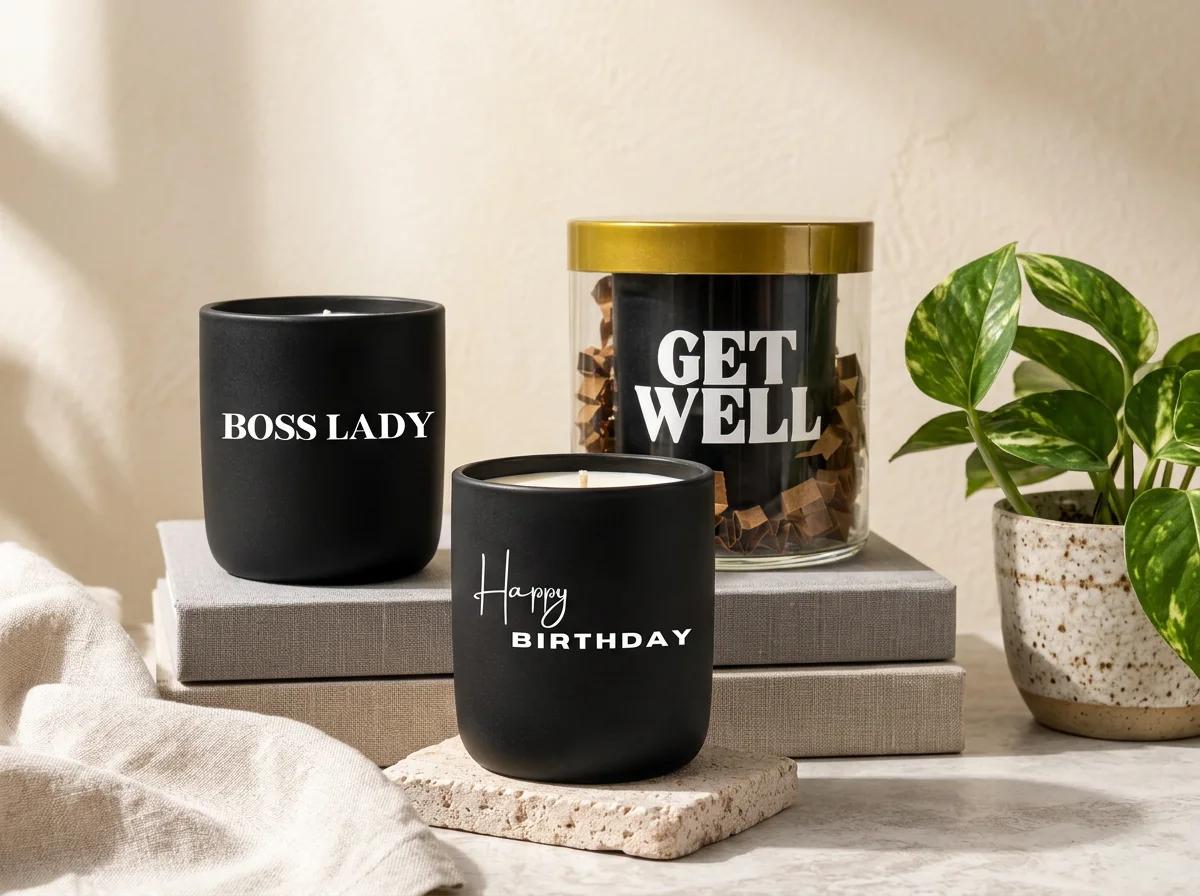
If you want a candle that carries a photo or a message, the same checklist applies, and it is the reason we built our process around it. Each of our personalized candles is poured in soy wax with a lead-free wick and a phthalate-free fragrance, then proofed by hand before it ships. Every order comes with keepsake packaging and a handwritten gift card.
You can start with personalized candles with a name and message or photo candles printed on soy jars. Planning a wedding? Our favours start from $18 per candle, with corporate and client gifting from $22 per candle, and boxed gift sets from $48, all on our gifting page.
A shopping checklist for paraben free candles
Before you buy any candle that makes a purity claim, run through these questions.
- Does the seller name the wick? Cotton or paper-core, and lead-free, stated plainly.
- Is the fragrance described? Look for phthalate-free, and for the scent source (fragrance oil or essential oil).
- Does the page mention the wax? Soy, coconut, beeswax or a blend, and whether paraffin is included.
- Are there burn instructions? Responsible makers tell you to trim the wick and not to burn unattended.
- Can you reach a person? Email a question. The speed and quality of the reply tells you a lot.
- Are the claims specific? “Free of parabens, phthalates and dyes” is a checkable list. “Toxin free” is not, because burning a candle makes combustion products by its nature.
If you want the bigger picture on whether candles are a concern at all, our article on whether candles are toxic goes through the evidence. And if scent choice is what you are stuck on, try choosing candle scents by room and mood.
FAQ
Do candles actually contain parabens?
Usually not. Parabens are preservatives for water-containing products such as lotions, and a candle has no water phase to preserve. A brand that advertises “paraben free” may be accurate, but the claim is often more marketing than meaningful. Ask about the wick and fragrance instead.
Are paraben free candles safer to burn?
Not necessarily. Safety depends on the wick, the fragrance, the wax and how you burn the candle. The National Candle Association says properly made, properly burned candles have no known health hazards, and researchers find that ventilation strongly affects indoor air. If you have asthma, are pregnant, or are sensitive to fragrance, ask your doctor about candle use.
Is soy wax paraben free?
Soy wax itself is a plant-based wax and is not a paraben. What matters is what the maker adds to it, such as fragrance, dye or additives. Always check the seller’s ingredient statement for the finished candle.
Are your candles paraben free?
We commit to phthalate-free fragrances and lead-free wicks in every candle, and we don’t publish a paraben-specific claim. If you need confirmation for a scent, contact us before ordering and we will tell you what we can verify.
Sources
- Amended Safety Assessment of Parabens as Used in Cosmetics (2020)
- FAQs, National Candle Association
- Candles and Incense as Potential Sources of Indoor Air Pollution, U.S. EPA
- Incense and Candle Burning: A Major Source of Phthalate Exposure, Indoor Air (2025)
- Clean Burning Soy Candle Review, WeApproveIt
- Human health risk evaluation of selected VOC, SVOC and particulate emissions from scented candles
- Real-time evaluation of terpene emissions during the use of scented wax products