













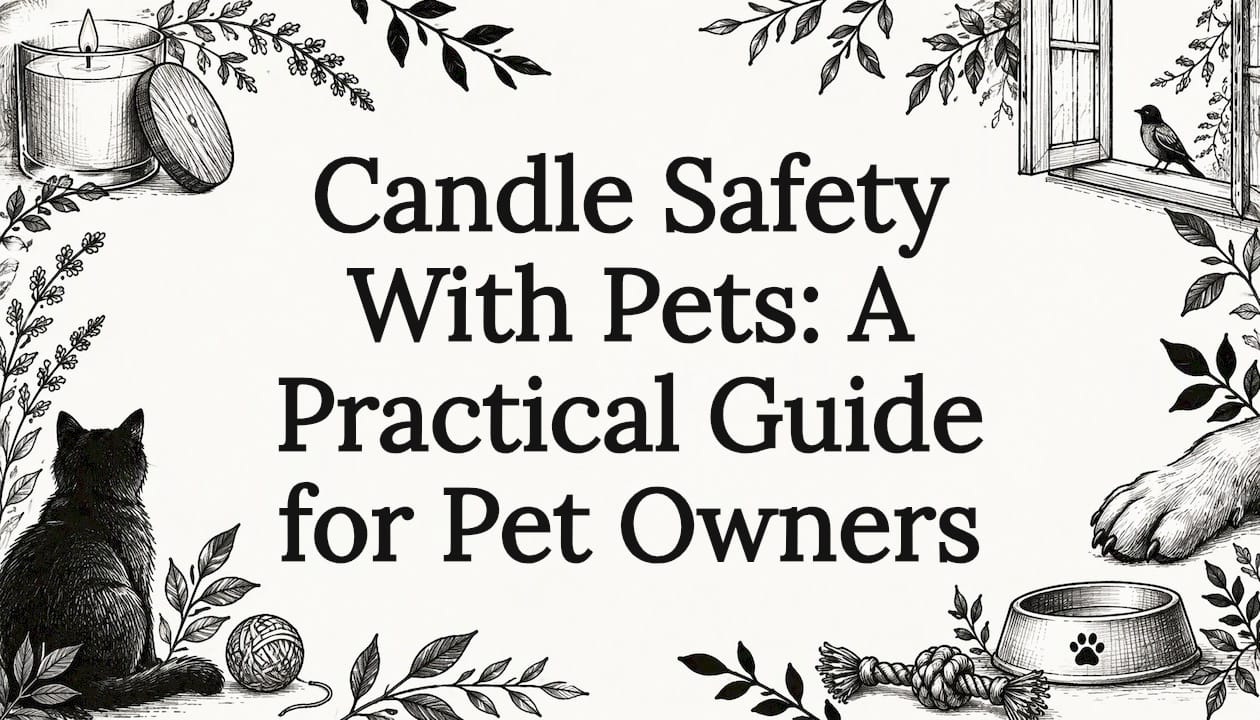
Candle Safety With Pets: A Practical Guide for Pet Owners
Candles can share a home with pets when you control three things: the flame, the air and the ingredients. The flame is the biggest everyday hazard, because pets knock candles over and get burned. The air matters next, especially for birds and cats. The ingredients matter last but are the part you can fix at purchase: plain soy wax, a lead-free wick and phthalate-free fragrance. Our candles are made that way, and the guide below shows how to use any candle more safely in a pet household.
TL;DR
- The most obvious candle dangers for pets are burns from flame or hot wax and fires from tipped candles, according to Pet Poison Helpline.
- Birds are the most sensitive species: the Association of Avian Veterinarians lists scented candles among airborne toxins that are not safe around them.
- Choose soy, beeswax, coconut or vegetable wax, a lead-free wick and phthalate-free fragrance, and keep the room ventilated.
- Never leave a flame unattended, and keep candles out of reach on a stable surface.
- Trouble breathing, tremors, collapse or repeated vomiting means a vet now.
Table of Contents
- The real risks: flame first, then air, then ingredients
- Dogs, cats and birds are not equally exposed
- What makes a candle a better choice for pet homes
- A safe-burning routine, step by step
- Smell good without the flame
- Signs that need a vet
- Our view on candles in pet homes
- A personalized candle built for your home
- FAQ
- Sources
The real risks: flame first, then air, then ingredients
Most pet owners worry about toxins first. The more common problem is simpler. Pet Poison Helpline’s senior veterinary toxicologist names burns from the flame or hot wax, and pets knocking candles over to start fires, as the most obvious dangers. The same source describes a kitten that had hot wax spilled on its fur and then ingested it, followed by vomiting and apparent convulsions. Candle wax itself can irritate the skin and stomach.
The second risk is what you breathe. The Merck Veterinary Manual explains that candles and reed diffusers are passive: they emit no actual oil droplets, so unless tipped over the main hazard is respiratory irritation. Active ultrasonic or nebulizing diffusers are different. They release microdroplets that settle on fur or feathers and get swallowed during grooming.
The third risk is ingredients: paraffin soot, lead-core wicks, phthalates and certain essential oils. These are the part a careful buyer controls.
Dogs, cats and birds are not equally exposed
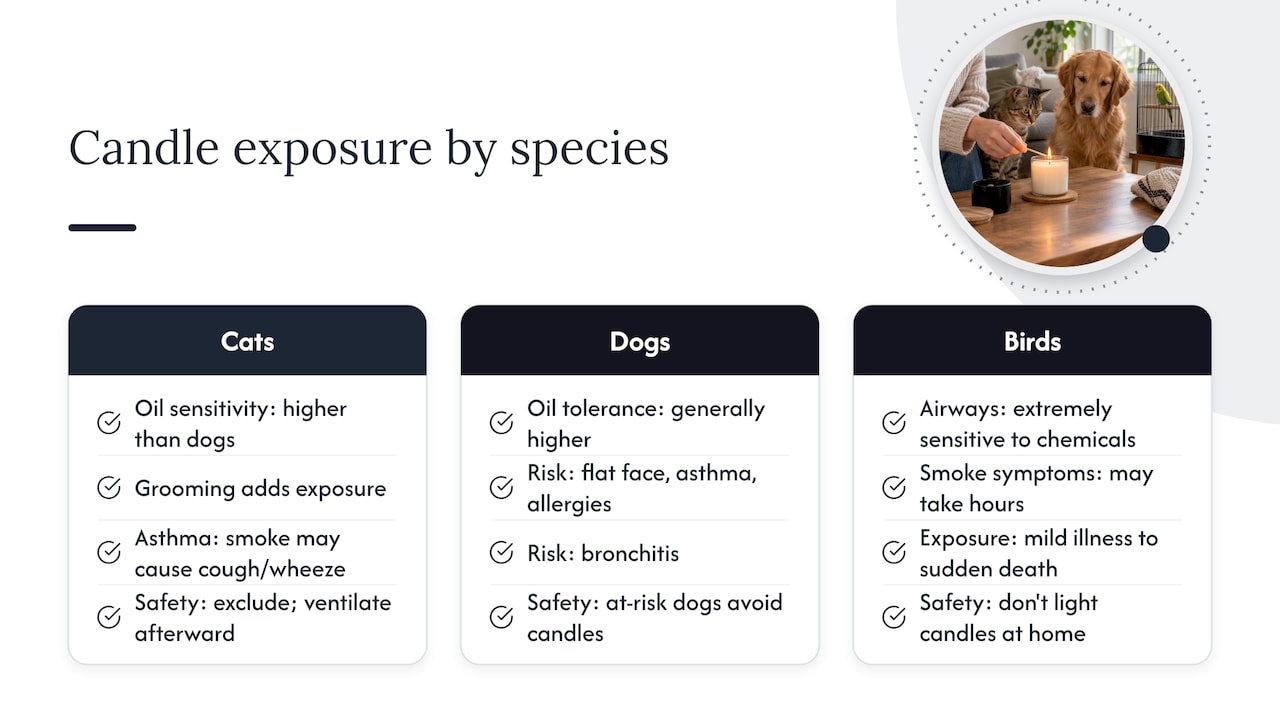
Cats. The Merck manual says cats are more sensitive to essential oils than dogs because they lack an enzyme called glucuronyl transferase, and grooming adds to their exposure. Cats with asthma can wheeze or cough in smoky rooms, so Cats.com suggests burning candles only in rooms the cat can’t enter and opening windows afterward. Curious kittens are also at particular risk of burns, as the ASPCA has warned.
Dogs. Dogs are generally more tolerant, but not immune. Rover, citing a veterinarian, advises that flat-faced breeds and dogs with asthma, allergies or bronchitis should avoid candles altogether. Our guide to candles and dogs goes deeper on warning signs.
Birds. Birds need the strictest rules. The Association of Avian Veterinarians says the avian respiratory tract is extremely sensitive to inhaled chemicals and that exposure can range from mild illness to sudden death. It also notes that smoke can cause symptoms that may take several hours to appear. If you keep a bird, the safest candle is the one you don’t light in the home.
For cat households, see also our cat candle guide.
What makes a candle a better choice for pet homes
Start with the wax. Rover, citing a veterinarian, rates plain soy, beeswax, coconut and vegetable-based waxes as low-risk for healthy adult dogs, and paraffin as higher risk. The US EPA’s concern about paraffin as a source of indoor air pollution is reported by Cats.com, which also recommends natural wax candles.
Then the wick. Lead-core wicks are banned in the US, but the same Rover guide notes that some imported candles may still have them. A lead-free wick removes that question.
Then the fragrance. Phthalates and naphthalene are on the high-risk list in that guide. Our fragrances are phthalate-free and our wicks are lead-free, and every candle is made from hand-poured soy. Our page on pet-safe candles explains what to look for, and our piece on what clean fragrance labels mean helps you read a label.
Essential oils: know the names
Most scented candles use fragrance oils, not essential oils, but if a label lists essential oils, check it against the veterinary lists. The Merck manual names tea tree as the most commonly reported essential oil intoxicant in pets. It also lists birch tar, cassia bark, cinnamon and pennyroyal as potentially liver-damaging, and birch, cedar, eucalyptus, hyssop, sage, wintergreen and wormwood as linked to seizures.
Rover’s list, citing a veterinarian, of scents more suitable for healthy dogs without breathing problems, in a ventilated room, includes lavender, vanilla, bergamot, frankincense and rosemary. If you want to confirm the oil content of a candle for a pet household, you can check it with us before you order.
A safe-burning routine, step by step
The fire-safety rules below come from the NFPA’s 2026 educational messages, unless noted.
- Choose the spot. Keep burning candles out of reach of pets and children, where they cannot be knocked over, and at least 12 inches (30 cm) from anything that can burn. Keep candles at least 3 inches (7.5 cm) apart. Our guide on where to place candles at home covers rooms and shelves.
- Trim the wick. Cut it to ¼ inch (6 mm) before each burn.
- Stay in the room. ASPCA Pet Health Insurance advises lighting a candle only when you are present, and blowing it out even for a few minutes away. Extinguish candles before leaving a room or going to bed.
- Ventilate. Open a window during and after burning, as Preventive Vet recommends for soy, beeswax or vegetable wax candles.
- Limit burn time. No more than four hours, then at least two hours of cooling before relighting.
- Put it out properly. Use a snuffer, which prevents hot wax splatter. Never use water.
- Keep birds away. Don’t burn candles in a room with a bird, or in an adjoining space sharing air.
A sturdy, heavy container helps too. Cats Protection suggests heavy candles that are less likely to topple, or a tray of water underneath.
Smell good without the flame
If you have a bird, a cat with asthma or a pet that can’t be kept away from a table, consider skipping the flame. The NFPA recommends battery-operated flameless candles as a safer option, and ASPCA Pet Health Insurance’s holiday tips suggest flameless LED candles where pets have access.
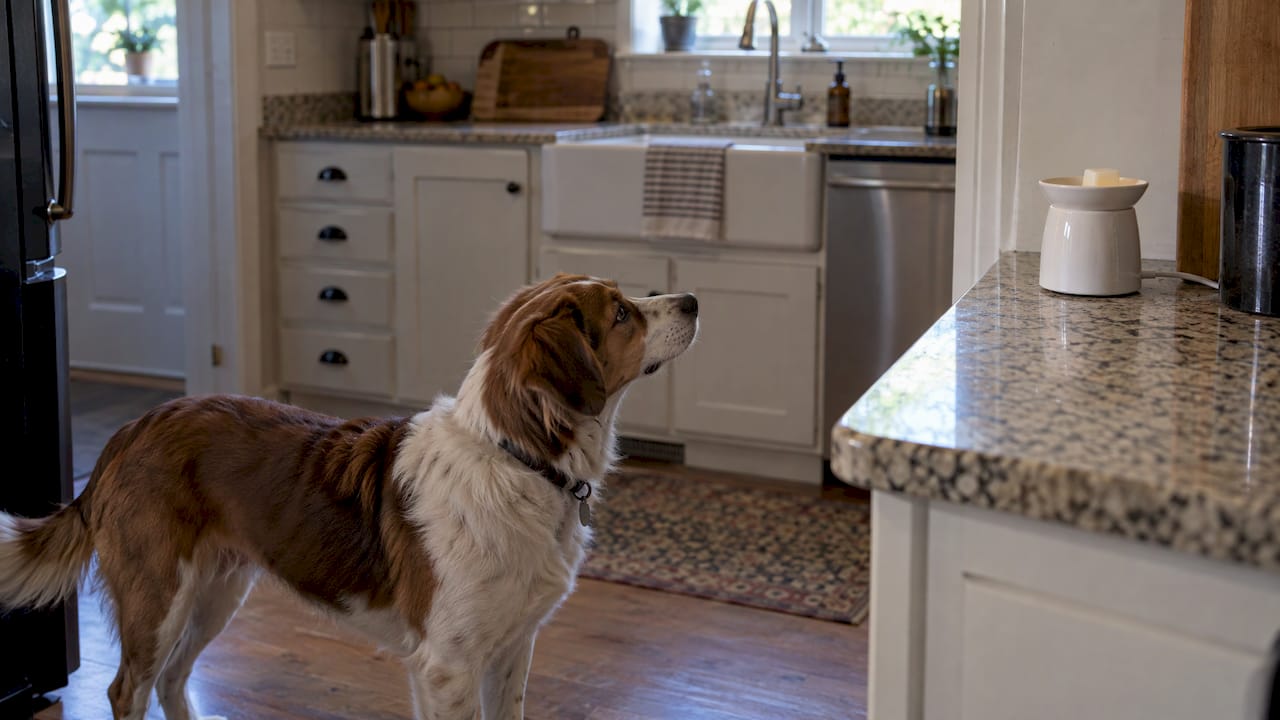
Preventive Vet also recommends a jar candle on a warming plate with auto-shutoff to keep the scent without the flame and smoke. A wax melt used in a warmer works the same way, but keep the warmer out of reach of pets, as the NFPA advises. Our wax melt bouquets are hand-sculpted and suit this use. For more ideas, see our pieces on eco-friendly home fragrance and pet odor candle ideas.
Avoid concentrated essential oils on or near pets. The Merck manual advises against applying them directly and keeping pets out of a room while a diffuser runs, using it for under 30 minutes.
Signs that need a vet
Go to an emergency clinic now if your pet shows trouble breathing, open-mouth breathing, collapse, seizures, tremors, repeated vomiting, or pale, blue or gray gums, as RexVet and Ellicott Street Animal Hospital describe. Milder signs after exposure include a watery nose or eyes, coughing, drooling or nausea. Pet Poison Helpline says to move the pet into fresh air immediately and to seek emergency care if symptoms don’t resolve quickly.
VCA Animal Hospitals adds that fragrance on the coat or breath, pawing at the mouth and a wobbly gait are warning signs, and says not to induce vomiting. If your pet ate wax, wick or fragrance oil, call your veterinarian, or the ASPCA Animal Poison Control Center at (888) 426-4435 (a fee applies) or Pet Poison Helpline at 855-764-7661, available 24/7.
Our view on candles in pet homes
Pet owners ask us the same thing: can I have a candle I love and still sleep well? Our answer is to start with what goes into it. We pour in soy, use lead-free wicks and phthalate-free fragrances, and proof every candle by hand before it ships.
The habits matter just as much as the wax. A good candle in the wrong spot is still a hazard, and a plain candle in the right spot is a pleasure. Put it high, keep it in view, ventilate, and snuff it when you leave.
If you have a bird, choose a flameless way to scent the home. We would rather you enjoy a personalized keepsake safely than burn it in the wrong room.
Jake
A personalized candle built for your home
We make personalized soy candles with your photo or words on the label, hand-poured and proofed by hand for print quality, and personalized orders ship within two days. Every order comes with keepsake packaging and a handwritten card. You can customize a candle by choosing wax, scent, label and packaging. Weddings and favors start from $18 per candle, and corporate gifting from $22 per candle, on our gifting page. Boxed gift sets start from $48.

Giving to a pet-owning couple? Our guide to pet-safe wedding scent ideas helps with favors.
FAQ
What types of candles are safe for pets?
Candles made from plain soy, beeswax, coconut or vegetable wax with a lead-free wick and phthalate-free fragrance carry the lowest ingredient risk. Even then, the flame and the air still need managing: keep it out of reach and ventilate.
What candle scents are not pet safe?
Oils such as tea tree, eucalyptus, wintergreen, cinnamon and birch are on the veterinary lists in the Merck manual or are flagged by Rover and Cats.com. Cats are the most sensitive of the common pets.
Can I use scented candles if I have a dog?
Many healthy dogs tolerate a well-made candle burned briefly in a ventilated room, out of reach. Dogs with asthma, allergies or flat faces should avoid them. Watch for coughing, sneezing or watery eyes.
How can I make my house smell good without harming my pets?
Ventilate first, then consider flameless candles or a warmer with auto-shutoff, kept out of reach. Avoid concentrated oils and active diffusers around birds and cats.
Sources
- Valentine’s Day Pet Dangers, Pet Poison Helpline
- Toxicoses From Essential Oils in Animals, Merck Veterinary Manual
- Protecting Your Pet Birds, Association of Avian Veterinarians
- Are Candles Bad For Dogs?, Rover
- Are Scented Candles Safe around Your Cat?, Cats.com
- ASPCA press release
- NFPA 2026 Educational Messages
- Fire Safety for Pets, ASPCA Pet Health Insurance
- Holiday Safety for Pets, ASPCA Pet Health Insurance
- Scents That Are Harmful to Dogs and Cats, Preventive Vet
- Cats and candles, Cats Protection
- Essential oil updates, Pet Poison Helpline
- Essential Oil and Liquid Potpourri Poisoning in Dogs, VCA
- Essential Oils Toxic to Cats, RexVet
- Holiday Candles and Scents, Ellicott Street Animal Hospital